Strain has a context
Stress is a response to difficult situations. In the short term it can help us respond. Persistent or excessive strain can affect sleep, concentration and wellbeing. A demanding week is not itself a diagnosis; its effect on everyday functioning also matters. [1]
A useful first question is: what is being asked of me, and what resources do I have? A full calendar does not reveal whether someone controls their deadlines, cares for a child overnight or carries responsibilities alone. We therefore start with the actual circumstances of a person’s life.
For a personal stocktake, simple notes are enough: which situations repeat? Where is there some breathing room? Which commitment could be negotiated? This is neither self-diagnosis nor another performance test. Its purpose is to make the next conversation easier.
Recovery also needs different conditions
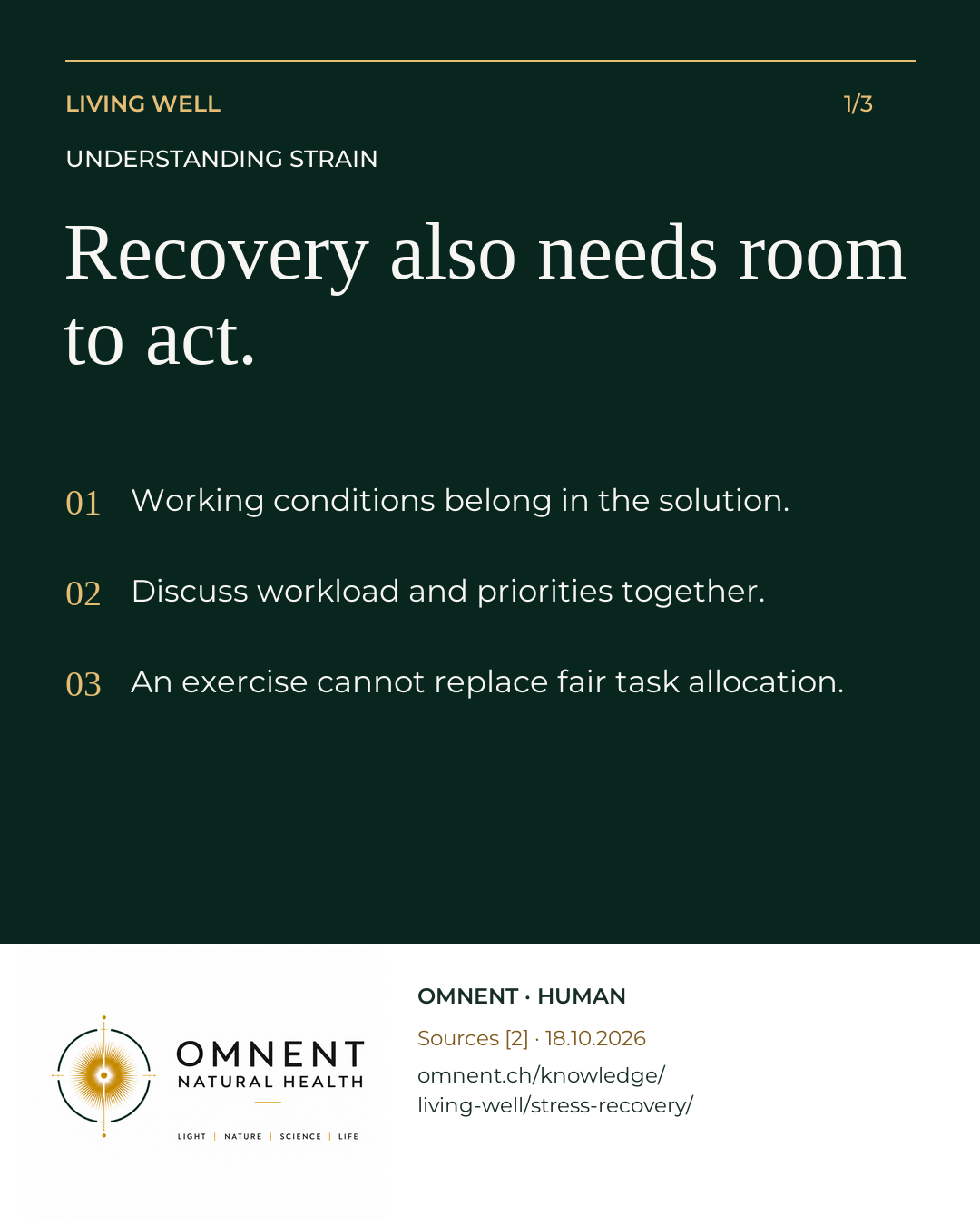
WHO recommends addressing psychosocial risks through organisational measures, including workload, work design and participation. This is a conditional recommendation supported by very low-certainty intervention evidence. It does not guarantee a particular outcome. [2]
For practical planning, separate three questions: what can I change myself? What needs an agreement? Where do I need support? Not everything belongs in the first category. Someone continually covering extra responsibilities may need a different division of work, rather than another task in their morning routine.
- Negotiate priorities explicitly: “If this task is added, which other task will we move?”
- Agree on availability: what is genuinely urgent, through which channel and until what time?
- For caring responsibilities, arrange a concrete handover: who takes which task, and when?
Sleep is not endlessly movable spare time
A free evening and an actual opportunity to sleep are different things. Consider which commitment repeatedly pushes back the end of your day. A small agreement within the household may be more workable than a long list of ideal sleep rules.
The laboratory study below shows why feeling accustomed to short nights deserves careful interpretation. It does not prescribe your personal sleep requirement or explain every form of exhaustion.
Van Dongen and colleagues studied 48 healthy young adults across two experiments. One comparison involved 4, 6 or 8 hours in bed over 14 days.
Short nights: perception and performance diverge
Finding. Attention-task performance deteriorated cumulatively with 4 and 6 hours. Subjective sleepiness did not fully reflect that progression.
Interpretation & limitations. Time in bed differs from time asleep. Laboratory conditions and young participants limit generalisation. The outcome was performance, not a universal individual sleep prescription.
Original source [8] ↗Movement without another performance demand
Choose a starting point that fits your actual day: perhaps a short walk or a familiar activity. This is a planning example, not a scientifically established minimum dose for stress relief. Someone already exhausted does not have to turn it into a new training project.
Singh and colleagues combined 97 reviews covering 1,039 randomised trials of physical activity in adults.
What the large overview actually examined
Finding. Symptoms of depression, anxiety and psychological distress improved on average. Participants and exercise programmes varied substantially.
Interpretation & limitations. Seventy-seven reviews had critically low methodological quality. The overview establishes neither that every activity helps everyone nor a general superiority over medication.
Original source [7] ↗Mindfulness: possible benefits, clear limits
Three questions matter more than an impressive promise: who took part? What was the comparison? And did researchers measure a questionnaire immediately afterwards or a longer-term health outcome?
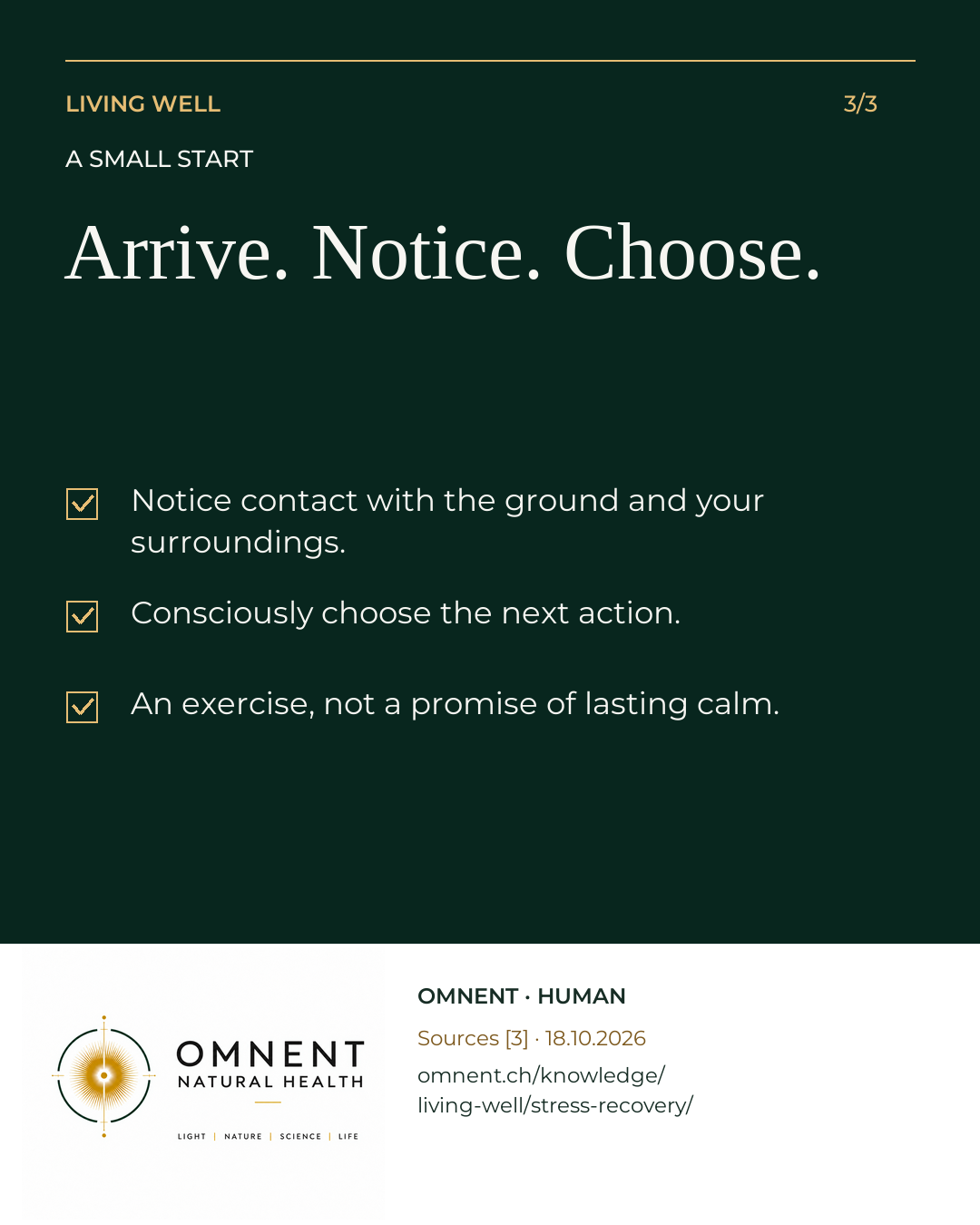
The WHO guide offers brief skills for coping with adversity. One option is to notice contact with the ground and the surrounding environment, then consciously choose the next action. It can be tried without demanding perfect calm from yourself. [3]
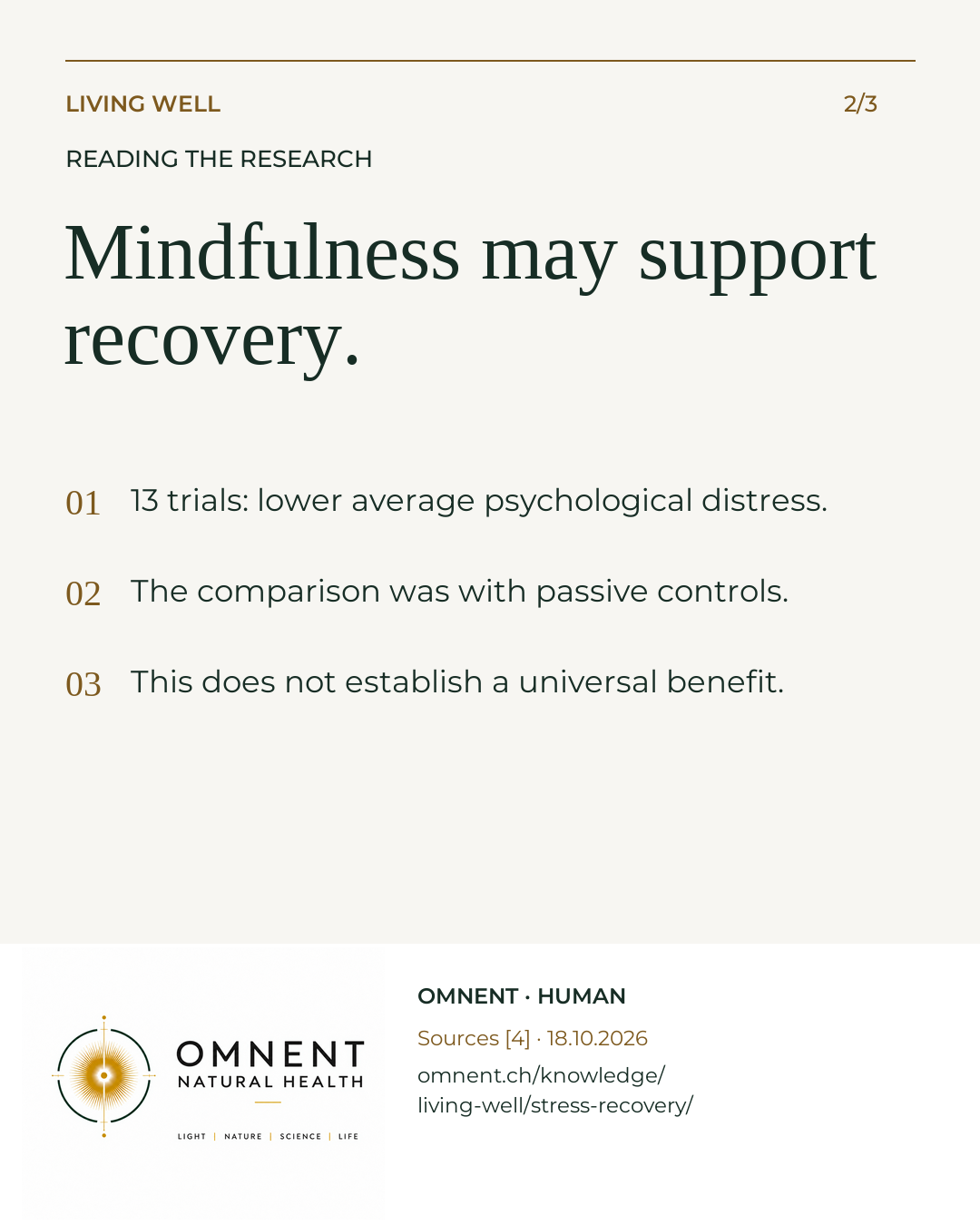
Galante and colleagues analysed individual data from 13 trials involving 2,371 adults.
Structured programmes in everyday settings
Finding. Compared with passive controls, psychological distress was lower at one to six months: standardised mean difference −0.32.
Interpretation & limitations. This does not mean a 32% reduction. Superiority over active alternative interventions was not established; evidence for that comparison was very uncertain.
Original source [4] ↗Rajan and colleagues included 17 randomised trials with 1,641 non-clinical adults in their 2026 review.
An updated review of perceived stress
Finding. Perceived stress was lower after intervention: standardised difference −0.53, 95% confidence interval −0.72 to −0.33.
Interpretation & limitations. Results varied substantially between studies, I² = 71%. Different programmes and controls complicate the pooled estimate. Physiological stress markers were not the central outcome.
Original source [5] ↗Sparacio and colleagues studied 2,239 people across 37 sites, comparing four brief mindfulness exercises with an audiobook excerpt.
A single exercise measures something different
Finding. Immediately afterwards, the exercise groups reported lower state anxiety, used here as a stress measure.
Interpretation & limitations. The mainly young sample and immediate self-report establish neither lasting disease prevention nor hormonal normalisation.
Original source [6] ↗Support can be specific
A meta-analysis of 148 prospective studies found an association between stronger social relationships and lower mortality. This is observational evidence, not proof that an individual conversation prevents illness. It does not establish an ideal number of social contacts either. [9]
Differences in health and life circumstances can contribute to these associations. An observational study therefore does not provide a precisely dosed social intervention. For an individual, it remains necessary to consider which form of connection or practical support fits their situation. [9]
As a practical approach, try making a request smaller and more specific: “Could you listen without immediately looking for a solution?” Or: “Could you take over this appointment on Thursday?” Support does not have to involve meeting more people or making every difficulty public.
Boundaries can be part of that approach. Declining an invitation may fit your circumstances better than turning recovery into another social obligation. Your own feedback is useful here: was the encounter helpful, neutral or additionally demanding?
When support should become professional
WHO advises seeking professional support when symptoms persist and interfere with daily functioning. Primary care or psychological care can provide an entry point. Stress should not become a blanket explanation for every new physical symptom. [1]
Before a first conversation, you might note when something changed, what has become harder in everyday life and what support you have already tried. You do not need to identify a diagnosis or successfully complete a self-help routine first.
If there is an immediate risk of harming yourself, seek urgent help through local emergency services or a crisis service. Do not face that situation alone. [10]
A CLOSER LOOK
Is that really true?
“I just need to be more resilient.”+
The conditions matter too.
WHO explicitly includes organisational change. An individual exercise cannot change unsuitable working conditions on its own. [2]
“Meditation resets my stress hormones.”+
That is not what these studies established.
The studies described here mainly measure perceived stress or state anxiety. They do not demonstrate a hormonal reset. [5] [6]
START SMALL
A manageable beginning
- 01
Write down one recurring source of strain and the specific situation behind it.
- 02
Choose one realistic change: hand over a task, agree an endpoint or protect some time.
- 03
After a few days, review what was actually workable. Adjust the plan rather than judging yourself for deviations.