An informed decision starts without judgement
Since March 2026, the Swiss EKSN has emphasised that drinking less is preferable for health. Earlier guidance values should no longer be presented as current safety thresholds. [2]
Perhaps you drink occasionally with food, or a glass is a familiar part of ending the working day. You may simply want to understand how research relates to your habits. Each starting point deserves clear information. A drink choice does not determine a person’s worth.
Separate quantity, long-term risk and practical steps. «How much is in my glass?» can be calculated. «What will happen to me?» cannot be answered by a single number. «What would I like to change?» should leave room for your circumstances.
Count grams, not just glasses
The approximate calculation is: beverage millilitres × alcohol percentage ÷ 100 × 0.8 = grams of alcohol. [3]
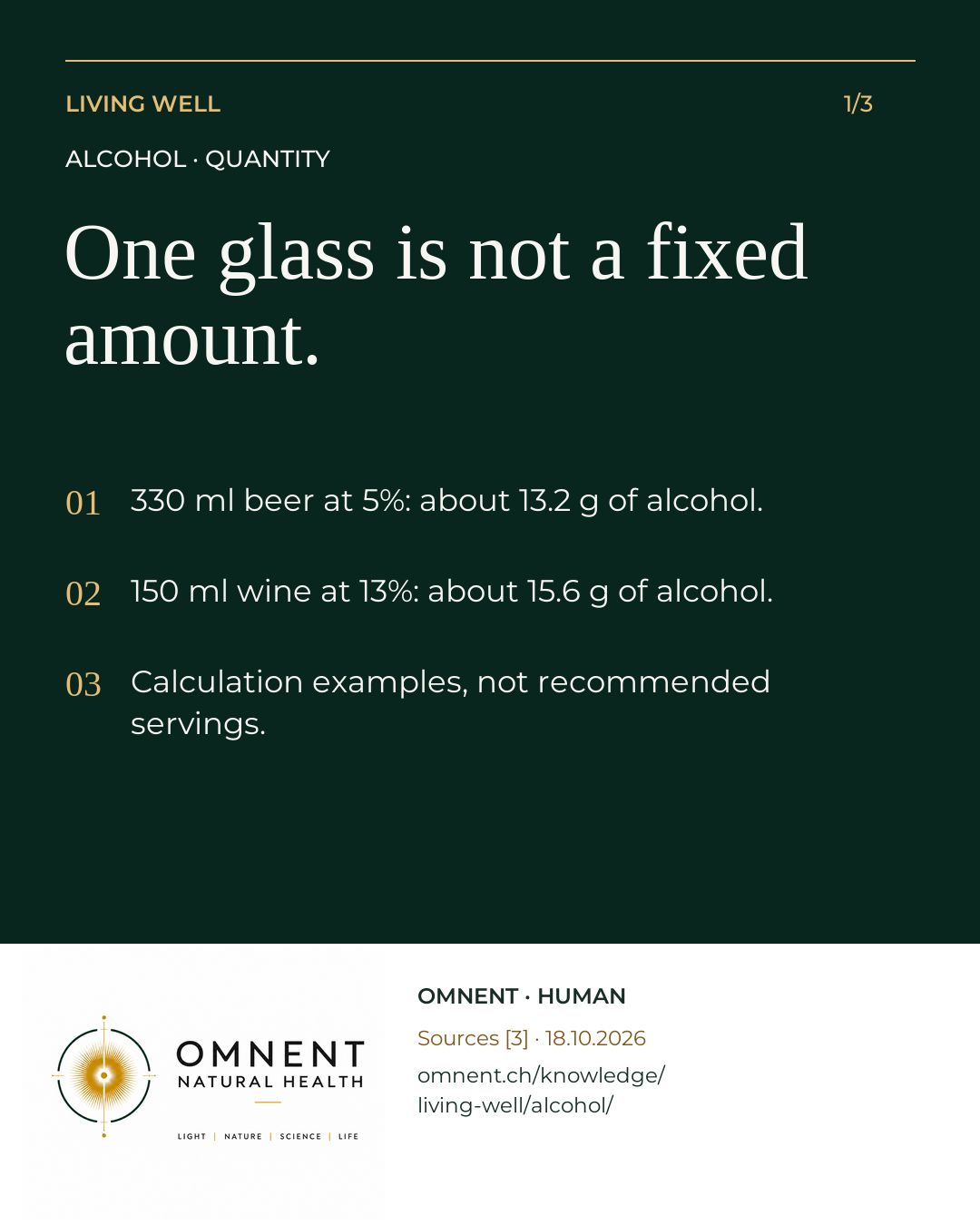
These independently calculated examples show why «one glass» is imprecise. They illustrate the arithmetic, not recommended serving sizes:
- Beer: 330 ml · 5% → 13.2 g alcohol. [3]
- Wine: 150 ml · 13% → 15.6 g alcohol. [3]
- Spirits: 40 ml · 40% → 12.8 g alcohol. [3]
- For your own notes, record volume, strength and occasion. Include top-ups; for mixed drinks, calculate the alcoholic components separately.
No safe threshold does not mean certainty
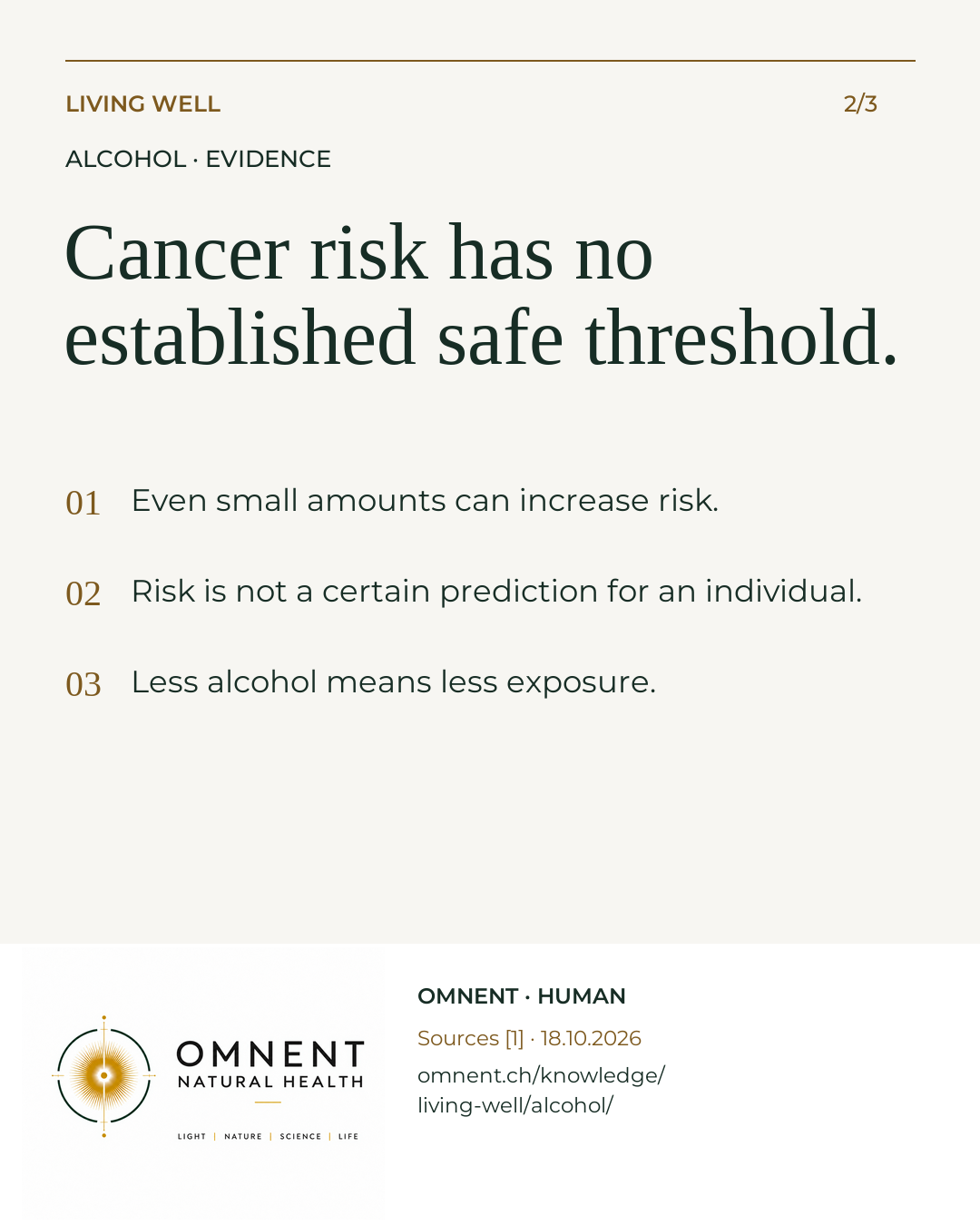
WHO identifies alcohol as a cause of at least seven cancers: oral cavity, pharynx, larynx, oesophagus, female breast, liver and colorectum. No risk-free level is established for cancer; wine is included. [1]
Risk describes probability. It does not mean every drink causes disease, nor that someone who remains well must have drunk without risk. A meaningful number needs an outcome, a period of time and a comparison group.
A purely mathematical example, explicitly not an alcohol-risk estimate: if risk rises from 10 to 11 cases per 1,000 people, the relative increase is 10%. The absolute difference is one additional case per 1,000. Without the starting risk, the same change can sound much larger or smaller than the number actually describes.
Ask which disease a headline concerns, how consumption was measured and how comparison participants were selected. Is it a statistical association or a justified causal conclusion? These questions matter even in very large studies.
Health benefits and sleep: what the studies show
A favourable group comparison does not automatically become a personal recommendation. These reviews address different questions. Mortality over years and sleep during an experimental night cannot simply be added into a single «healthy» or «unhealthy» score.
Meta-analysis of 107 cohorts including approximately 4.84 million people.
No established survival advantage from drinking a little
Finding. After accounting for methodological differences, including former drinkers in comparison groups, occasional or low consumption showed no statistically established advantage for all-cause mortality.
Interpretation & limitations. Observational studies, not random allocation to years of drinking. Residual confounding and measurement error remain possible; the analysis does not establish a personally safe dose.
Original source [4] ↗Systematic review and meta-analysis of 27 studies in healthy adults.
Feeling sleepy is not the same as restorative sleep
Finding. Alcohol delayed and reduced REM sleep, with greater disruption at higher doses. Faster sleep onset appeared only at high experimental doses.
Interpretation & limitations. Short-term sleep measurements. Findings for total sleep time and sleep efficiency were uncertain; this establishes neither a sleep treatment nor how a particular person will feel the next morning.
Original source [5] ↗Make change specific
If physical dependence is possible, medical planning comes first; warning signs follow below. Otherwise, for an everyday situation, consider the setting: When does the decision happen? Who tops up the glass? What are you hoping for in that moment?
Make a plan specific: decide on your drink before ordering at a restaurant. If hosting, offer an appealing alcohol-free selection. Or prepare a sentence that needs no justification: «I am staying with this drink today.» These are planning examples, not a tested treatment.
If a plan fails, note the difficult situation rather than judging yourself. What was missing: an alternative, support, a clear decision or professional assessment? That makes the next step more concrete. You do not need a public promise to take a concern seriously.
Cochrane review of 69 trials; the main analysis included 34 trials with 15,197 primary-care participants.
Brief advice can make a modest difference
Finding. At one year, brief intervention reduced consumption by an average of about 20 g per week versus minimal or no intervention; moderate-certainty evidence.
Interpretation & limitations. Effects varied substantially between studies. The focus was hazardous drinking, not an independent withdrawal programme. The search ran to September 2017; individual success is not guaranteed.
Original source [6] ↗IARC evaluation of epidemiological and mechanistic evidence on reducing or stopping alcohol consumption.
Reducing consumption and cancer: distinguish the outcomes
Finding. Sufficient evidence for fewer oral-cavity and oesophageal cancers compared with continued consumption.
Interpretation & limitations. For other alcohol-related cancers, evidence for risk reduction was limited or inadequate. That does not challenge alcohol’s causal role in those cancers. The evaluation does not supply a personal timetable for risk to normalise.
Original source [7] ↗Dependence: plan withdrawal with medical support
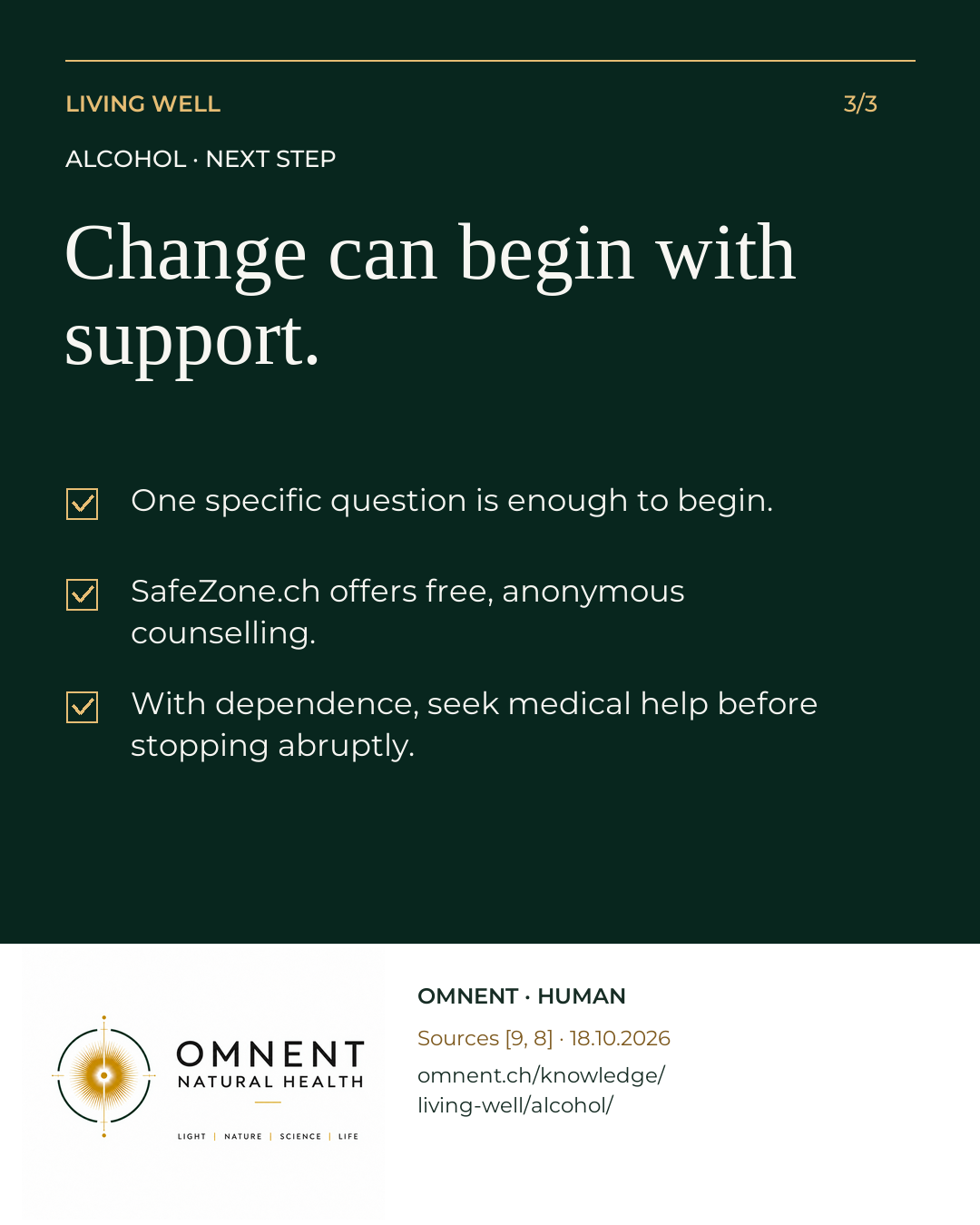
With physical dependence, stopping abruptly can be dangerous. Shaking, sweating or nausea when cutting down are reasons to seek medical help first. Seizures, hallucinations or confusion can indicate severe withdrawal and are an emergency. [8]
In Switzerland, call 144 for medical emergencies. For ongoing care, the Federal Office of Public Health directs people to medical services and specialist addiction services. [10]
SafeZone.ch offers free, anonymous online counselling by addiction professionals. This written service supports questions and next steps; it is explicitly unsuitable for emergencies. [9]
The EKSN recommends avoiding alcohol during pregnancy and breastfeeding, before driving and during hazardous activities. Possible interactions with medication should be checked with a clinician or pharmacist. [2]
You can seek help before deciding what to call your drinking. Write down what concerns you, what you have tried and what support you would like. Relatives can also describe the strain they experience.
A CLOSER LOOK
Is that really true?
A daily glass of red wine is preventive healthcare.+
Not a sound reason to start.
The large cohort review does not establish a survival advantage from low consumption. An observation is not a prescription. [4]
If alcohol helps me fall asleep, it improves my sleep.+
Sleep onset and sleep quality differ.
The sleep review found changes in REM sleep. A sedating impression is not evidence of restorative sleep. [5]
START SMALL
Three questions for a next step
- 01
Could dependence be involved? Begin change with medical support.
- 02
What is in the drink? Read its volume and alcohol percentage and make a factual note without grading yourself.
- 03
What would you like: greater clarity, a different habit or support? Formulate one question for yourself, someone you trust or a counselling service.