Start with the dog in front of you
A puppy, an adult dog and a senior have different starting points. AAHA recommends considering development, experience, environment and individual needs together; exercise and engagement should also suit the animal. Behaviour therefore belongs in routine veterinary care. Rest is not an isolated training target that can be evaluated independently of the rest of a dog’s life. [1]
A useful everyday question is: what has changed for this particular dog? Comparing them with a neighbour’s dog rarely answers that. Record specific situations instead: getting up at every door sound, repeatedly changing resting places, or newly being unable to lie down after a walk. A concrete description gives you something that can be reviewed later.
Owner reports for 2,332 dogs at 16 weeks and 1,091 at twelve months.
What a large puppy cohort actually shows
Finding. Younger puppies were reported to sleep longer.
Interpretation & limitations. Estimates rather than measured sleep, with inconsistent definitions of daytime and night-time. These do not establish a universal minimum.
Original source [2] ↗Body language needs context
Tension may involve freezing, moving away, a lowered posture or increased panting. One yawn or lip lick cannot establish a diagnosis. The situation, several concurrent signals and departure from usual behaviour need to be considered together. A review of veterinary settings emphasises early recognition and adapting interactions; petting is appropriate only when the animal clearly enjoys it. [3]
Keep observation separate from interpretation. “He turns his head away when the visitor approaches and moves behind the sofa” can be checked. “He is offended” is a guess. When speaking to a professional, the trigger, distance, duration and what happened next are more useful than a label.
- What happened immediately beforehand, and who was present?
- Which movements, sounds and postures could actually be seen?
- What changed when the situation ended or distance increased?
A retreat that stays dependable
Fear cannot reliably be resolved by forcing an animal to endure it. AAHA warns against overwhelming exposure to frightening stimuli and keeping frightened dogs in situations or crates. A retreat needs to fit the dog’s experience. A crate is not automatically a safe place simply because a person calls it one. [4]
For a practical home review, mark the dog’s preferred resting place on a sketch. Add the routes to the kitchen, entrance and bathroom. If the bed sits directly in a busy passage, you can offer a quieter alternative without immediately removing the existing option. What matters afterwards is actual use, rather than how the arrangement looks in a photograph.
Agree on a simple household rule: a resting dog is not approached there for photographs, games or visitor interactions. Children need active adult supervision. Write the rule clearly enough that guests also understand what to do. After several days, check whether the agreement has actually been followed rather than assuming that everyone interpreted it in the same way.
Being asleep and feeling relaxed are different
For your own notes, distinguish between “lying quietly”, “appears asleep” and “wakes repeatedly”. Without measurement, we do not know the sleep stage. A short video can supplement a description, but should show a situation that already occurs. Deliberately creating a distressing trigger to obtain a recording is not a useful observation method.
Sixteen adult pet dogs underwent three-hour sleep recordings after positive and negative social experiences. Each dog experienced both conditions.
Experiences before sleep change its pattern
Finding. After negative experiences, dogs fell asleep sooner, while the distribution of sleep stages changed.
Interpretation & limitations. This was a small experimental sample with deliberately limited situations. Falling asleep quickly therefore does not establish relaxation, and the study does not prescribe a sleep routine for every home.
Original source [5] ↗Offer clear guidance without adding pressure
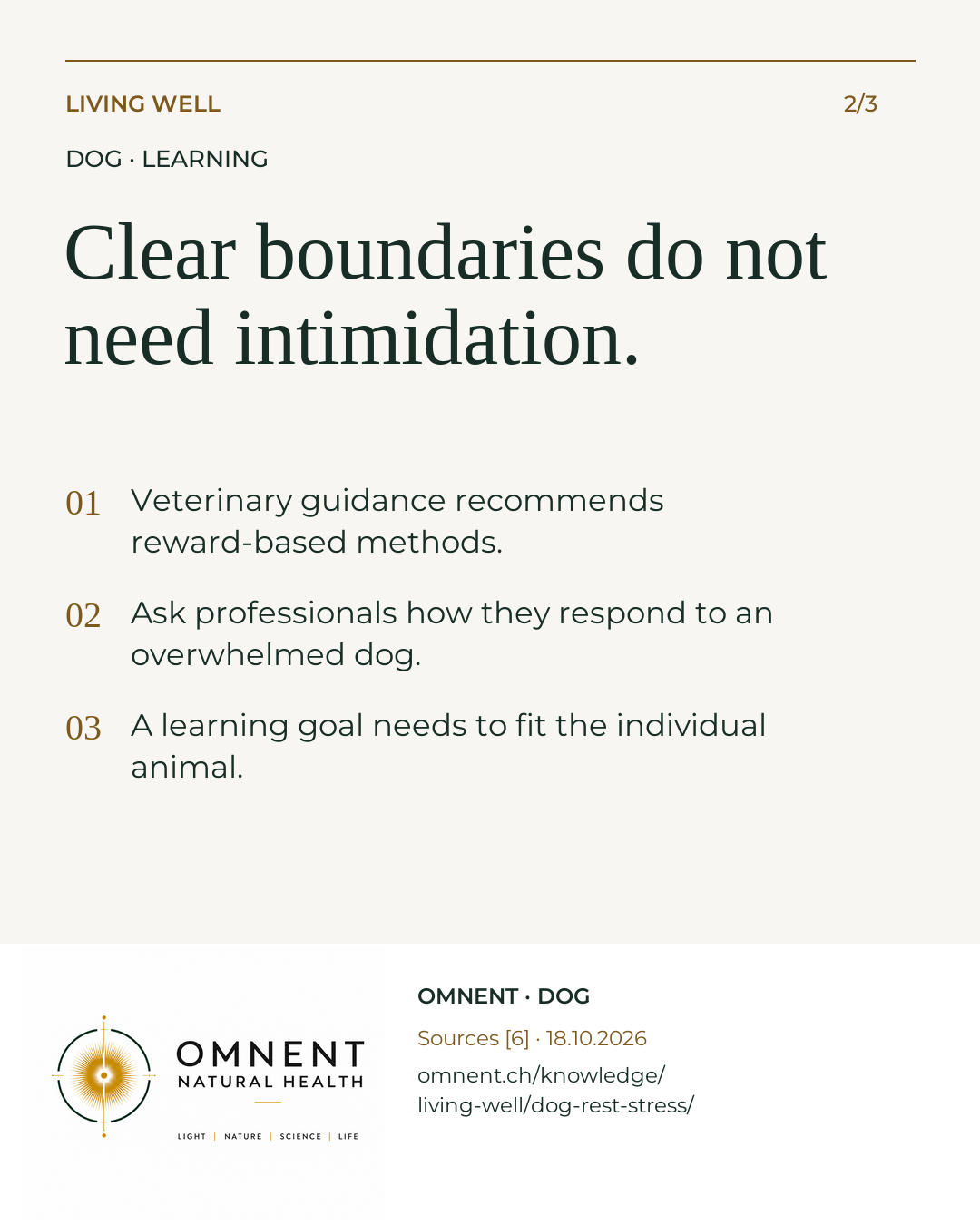
AVSAB recommends reward-based methods for everyday training and behavioural concerns. These involve achievable expectations, suitable reinforcement and an environment that enables the desired behaviour. Startle, pain and intimidation are not required. A qualification alone reveals little about actual practice: ask a professional to explain what they do when a dog is frightened, overwhelmed or needs to stop. [6]
Define an achievable goal instead of an abstract demand such as “He must finally relax”. For example: the dog can remain in the living room while a familiar person stands up. Agree with the supporting professional how to recognise an appropriate difficulty level and when to step back. Progress then becomes something you can discuss without claiming to know an internal emotional state.
Ninety-two dogs from seven training schools were compared using behaviour, salivary cortisol and a task involving ambiguous cues.
Training and welfare: more than obedience
Finding. Dogs at schools using high levels of aversive methods showed more distress-related behaviour and greater cortisol increases than those at reward-based schools; task responses were also less favourable.
Interpretation & limitations. Dogs were not randomly allocated to schools. Differences between animals and people may contribute; this was not a randomised effectiveness comparison of every individual technique.
Original source [7] ↗Being left alone deserves its own assessment
If restlessness occurs mainly around departures, an attractive bed is not a sufficient explanation or solution. AAHA identifies video as useful because behaviour during absence often goes unnoticed. Persistent separation-related difficulties require individual professional assessment. [4]
An exploratory Generation Pup analysis examined 145 dogs with complete, eligible records up to six months of age.
Early experience and later separation-related behaviour
Finding. Early sleep reports, housing arrangements and responses to unwanted behaviour were associated with later separation-related signs.
Interpretation & limitations. Owner reports, extensive exclusions and the absence of an intervention limit interpretation. The findings establish neither a reliable sleep threshold nor a reason to confine a frightened puppy. They also cannot clearly separate causes from people’s responses to existing problems.
Original source [8] ↗When rest becomes a medical question
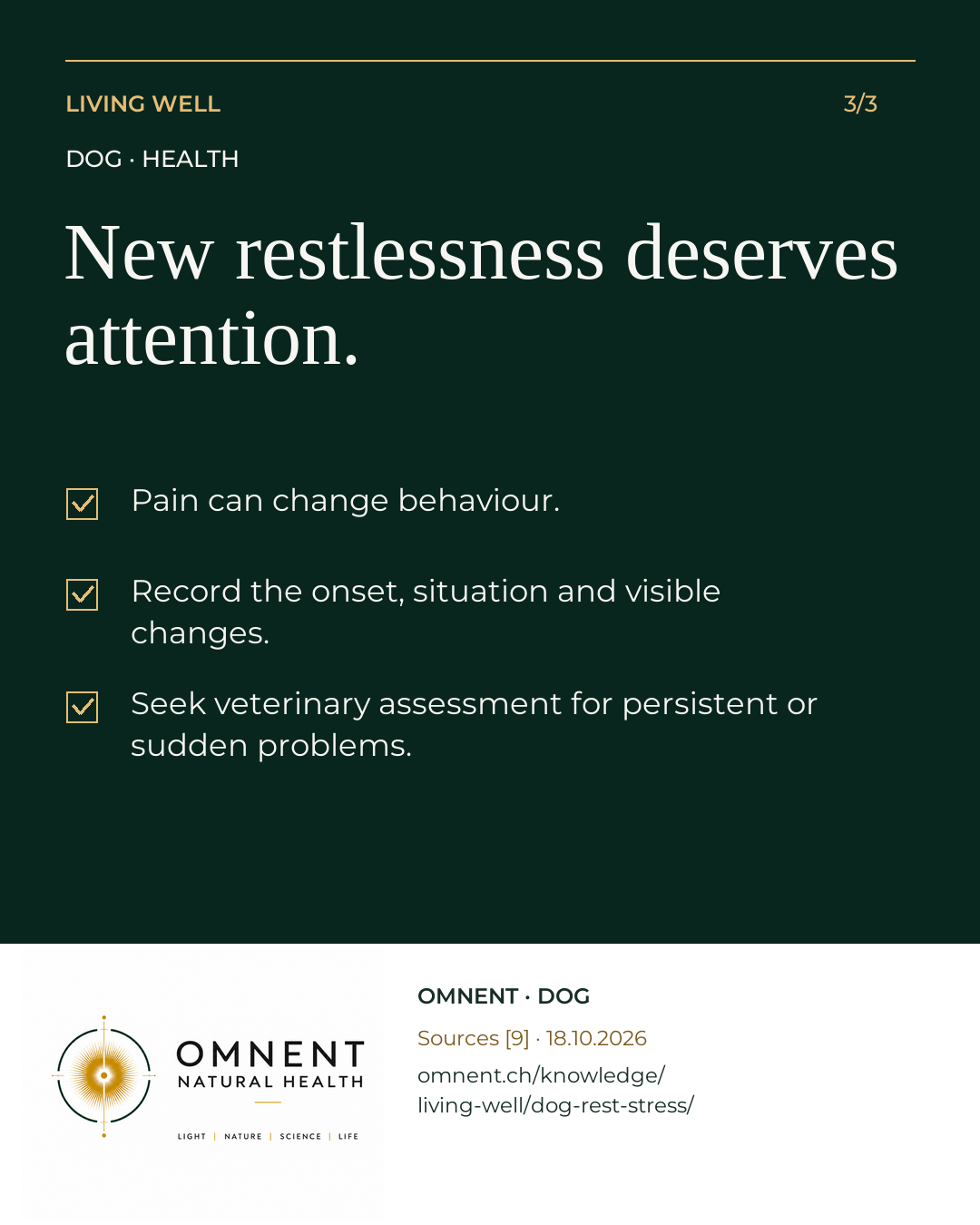
Pain may cause defensive behaviour, withdrawal, altered movement or apparent training problems, and may worsen existing anxiety. Mills and colleagues illustrate these connections using published literature and referral cases. Sudden or persistent changes therefore warrant veterinary assessment. Figures from specialist referral services do not describe pain prevalence in the general pet-dog population. [9]
Bring a short timeline: when the change began, the situations involved, any change in movement and available recordings. Add known conditions and current medicines. The aim is not to produce your own diagnosis, but to give the examination a clear starting point. If the situation deteriorates acutely, do not wait until a week’s observation record is complete.
Observe for a week, make changes deliberately
Use a manageable organisational exercise: observe first, then document one clearly described change. This is neither treatment nor a validated stress measurement. It simply helps turn a vague impression into an account that another person can understand. If the bed, timetable and training all change together, it becomes difficult to say which difference was actually noticed.
A useful entry includes the date, situation, observed behaviour and changes made. Include uneventful days too. At the end, look beyond whether the dog made less noise: was the retreat used, were interruptions less frequent, and was the household agreement followed? Take unresolved questions to the next professional discussion. A record is useful when it makes those questions clearer, not when it produces a score that looks reassuring.
A CLOSER LOOK
Is that really true?
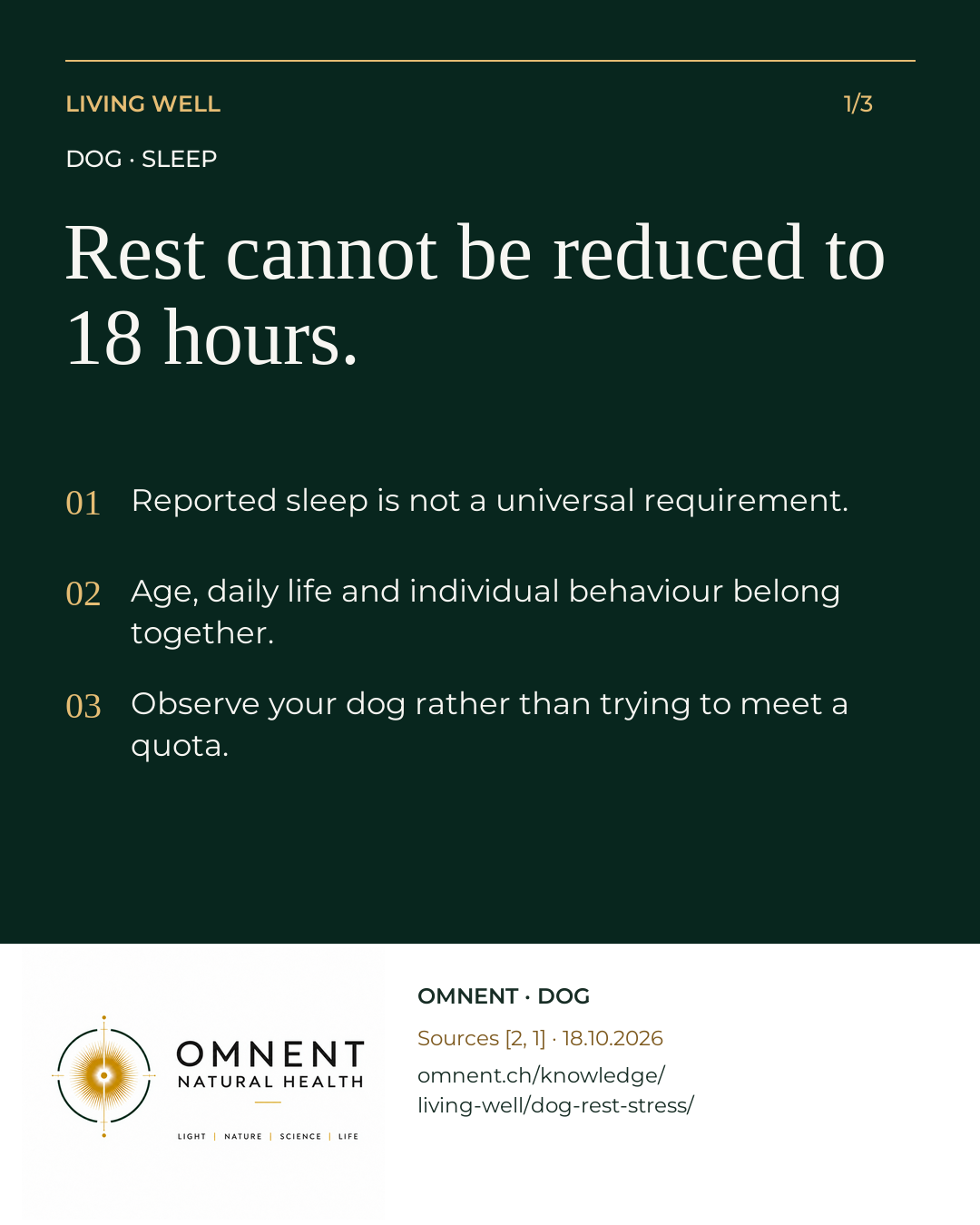
Every dog needs exactly 18 hours of sleep.+
Not a universal requirement
The cited cohort study does not determine optimal sleep duration for every animal. [2]
A quiet dog is automatically relaxed.+
An incomplete interpretation
Freezing can also accompany fear. Posture, circumstances and how behaviour develops tell us more than sound alone. [3]
START SMALL
Three small steps for today
- 01
Write down one specific situation in which rest is frequently interrupted.
- 02
Review one resting place against the routes people take through the home.
- 03
Agree on one clear household rule and a time to discuss whether it was followed.