Good housing starts with actual needs
A quiet room with food and a soft bed may seem complete to a person. For a cat, what they can do and choose there also matters. AAFP describes indoor cats’ physical and emotional needs as an essential part of their care. A species-appropriate environment belongs in preventive healthcare; it is not an optional entertainment programme. [1]
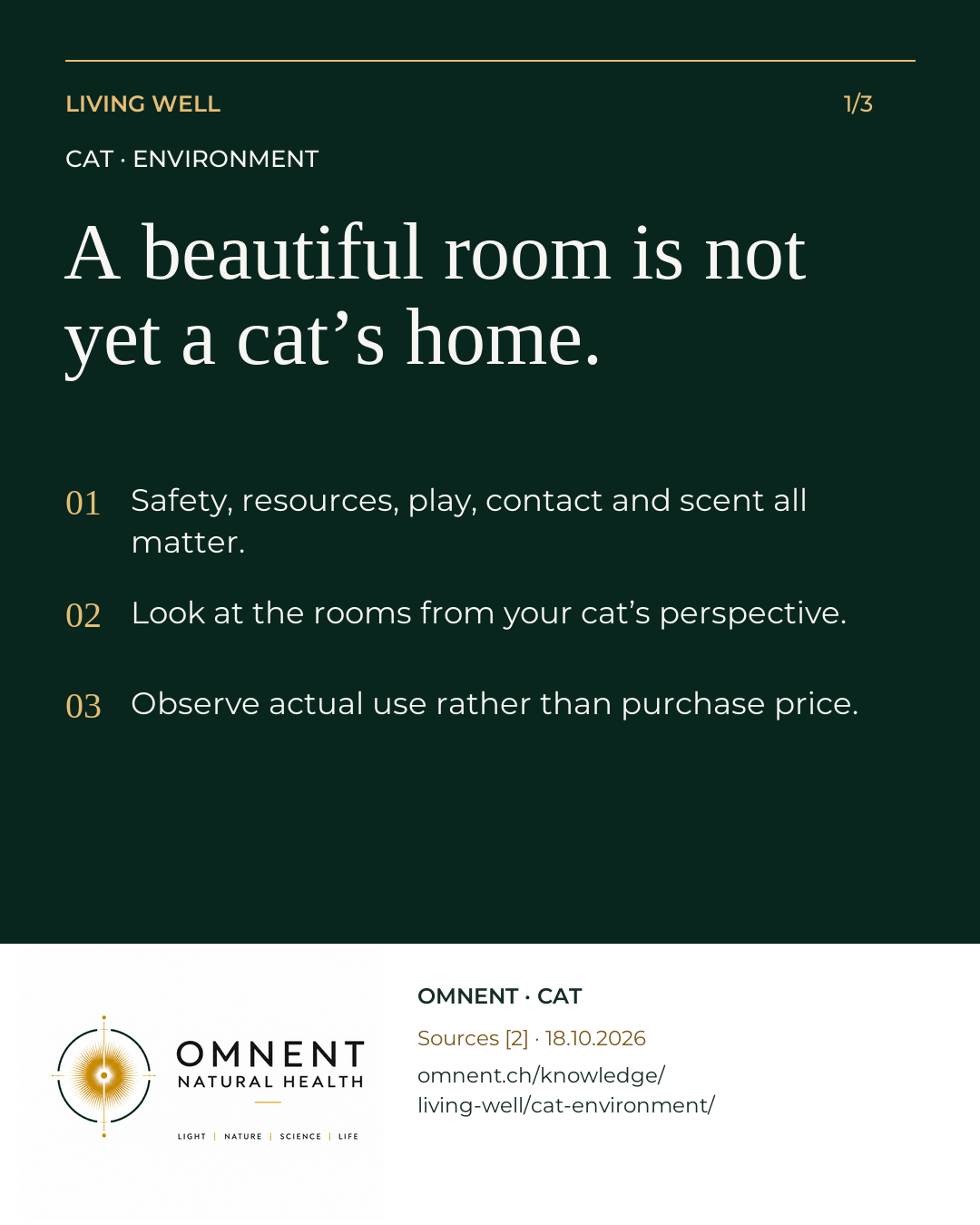
The AAFP/ISFM guideline groups needs into five areas: safe retreats, separated key resources, hunting and play, dependable positive contact, and respect for the sense of smell. [2]
View the home as a map of opportunities. Where can the cat watch, pass unnoticed or end an encounter? An arrangement’s value is not determined by its price. For your own planning, a simple option that is used tells you more than an elaborate piece of furniture that is consistently ignored. Record actual routes before buying additional equipment.
Hiding can be a useful choice
Elevated observation places also belong in the design. AAFP specifically includes usable vertical space as part of an appropriate indoor environment. [10]
Offer a retreat as an invitation: accessible, stable and without placing the cat inside. For the home review, distinguish “the place exists” from “the cat uses it voluntarily”. Photograph the empty arrangement instead of positioning the animal for comparison pictures. This keeps the record an observation rather than a staged demonstration.
Twenty-three newly admitted shelter cats were randomly assigned to housing with a hiding box or a control condition and observed for twelve days.
A hiding place in a shelter
Finding. Behavioural stress scores fell faster with a box. Weight loss did not differ significantly between groups.
Interpretation & limitations. A small single-shelter study. Hiding opportunities did not replace comprehensive care; the result establishes neither an effect in every home nor the meaning of every instance of hiding.
Original source [3] ↗Access matters more than the total count
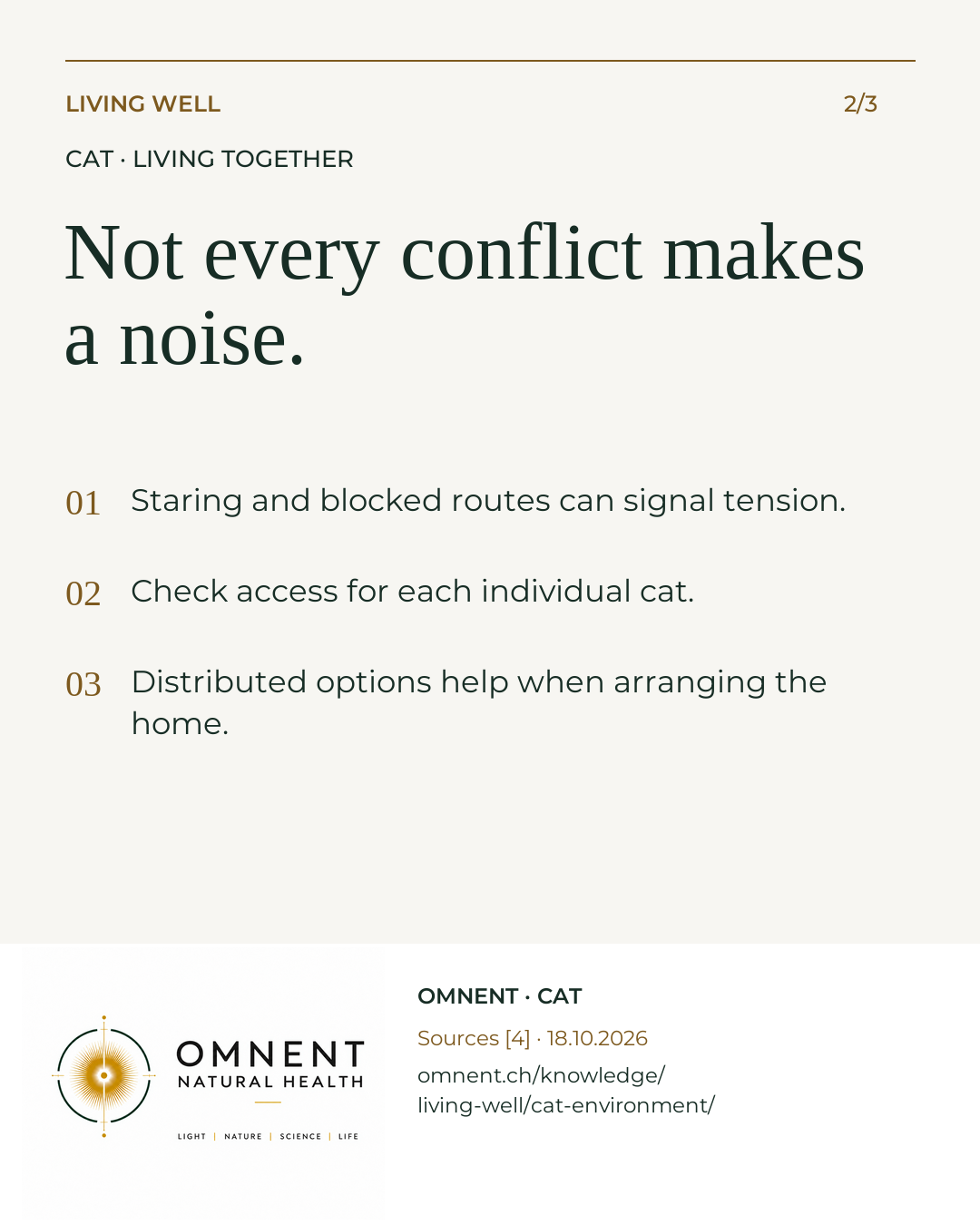
Tension between cats can be subtle: staring, blocking and avoidance matter even without fighting. AAFP recommends dispersed resources with visual separation and several retreat options. Feeding stations, litter trays, scratching areas and resting places should be accessible without one cat repeatedly having to pass another. [4]
Give each cat a colour on your home map. Mark routes to food, water, litter trays and preferred places. Where must everyone use the same narrow passage? Where is a bowl available but only used at night? These questions can reveal a possible access problem without already making a diagnosis.
Check use at different times of day. Three available objects do not necessarily create three independent options. If you add a station, record its location and who actually uses it. Do not assess the household only by the total amount of food eaten or number of litter visits: those totals can conceal differences between individual cats and make a useful discussion less precise.
Hunting and exploring at an individual pace
Dantas and colleagues describe food puzzles as one possible form of enrichment. Initial tasks should be easy and matched to the cat’s abilities. Individual preferences differ. The paper offers practical recommendations and case examples; it does not establish that a particular toy generally treats obesity, anxiety or urinary disease. [5]
For planning, sort opportunities by activity rather than product category: watching, following, reaching, catching or finding food. Record which the cat initiates voluntarily and when they stop. A brief interested engagement can be more informative for this exercise than a long session maintained through repeated prompting.
Food tasks can be mobile or stationary, including options for wet food. An accessible task with familiar food can initially sit alongside the usual bowl. Some cats prefer exploring it in a quiet place. Adapt the arrangement if reaching it is physically difficult. [5]
Take familiar smells and routines seriously
Cats use scent for orientation and communication. The environmental guideline recommends respecting familiar scent marks. Familiar bedding can help during a change of location; this does not establish a need for a particular scent product. [2]
For your own overview, keep a brief change calendar: visitors, building work, furniture changes, a new caregiver or altered work hours. It can help you discuss timing later. Events happening together do not establish causation. Equally, an unchanged calendar does not rule out physical illness.
Twelve healthy cats and 20 cats with interstitial cystitis were observed in research housing for 77 weeks. Eleven weeks contained unusual external events.
Unusual events and sickness behaviours
Finding. Both groups showed more sickness behaviours during those weeks, including reduced food intake or elimination problems.
Interpretation & limitations. An observational study with shared care, not an experiment in ordinary homes. An external event does not automatically explain the cause of an individual animal’s symptom.
Original source [7] ↗Environment and medical care belong together
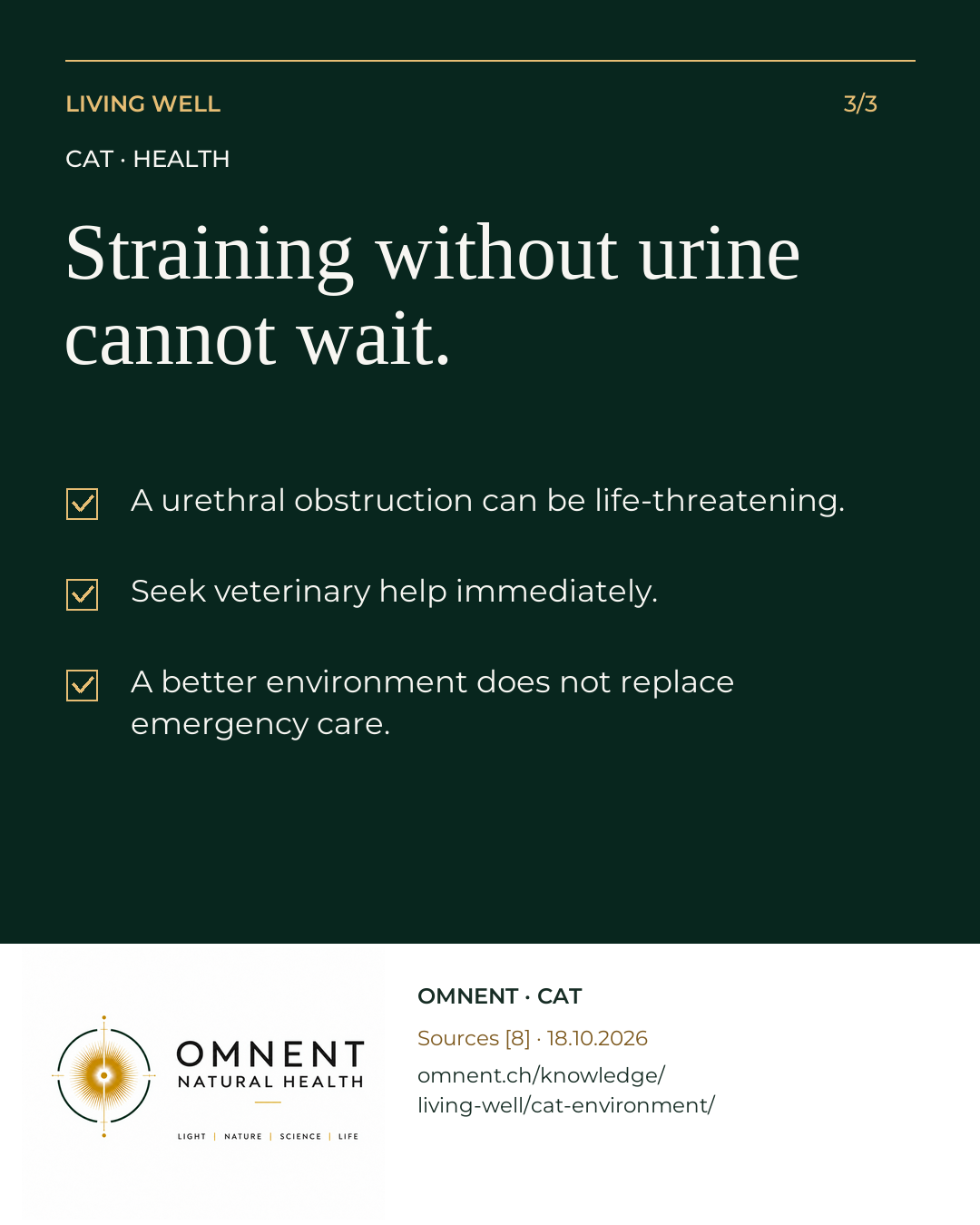
The 2025 iCatCare guideline treats urinary signs as complaints with several possible causes. Repeated straining with little or no urine can indicate a life-threatening urethral obstruction: seek veterinary help immediately, especially for male cats. Blood in urine or new house-soiling also needs assessment. Environmental changes replace neither examination nor necessary treatment. [8]
Forty-six indoor cats with diagnosed idiopathic cystitis were followed for ten months after individual changes to their environment and care.
Multiple environmental changes for bladder signs
Finding. Caregivers reported fewer urinary signs and improvements in other complaints.
Interpretation & limitations. No randomised control group, several measures together and subjective reports. Natural fluctuations and other influences cannot be excluded. The study supports further investigation of the approach, but does not establish that one particular measure cures disease.
Original source [9] ↗A good environment develops with the cat
AAFP’s 2024 position describes benefits and risks of indoor-only, outdoor and combined lifestyles. An appropriate decision considers the individual cat and local surroundings. Protected outdoor areas can be an option; no lifestyle automatically meets every need. Indoor design therefore remains relevant even when a cat goes outside. [10]
Start with one specific bottleneck on your map. Decide what you will change and how you would recognise actual use. An additional option can be offered while a familiar one remains available. Avoid redesigning the entire home simply because the first attempt is not adopted immediately.
After a week, collect observations rather than grades: who used the new place? At what times? Which routes were taken? What remains unclear? Discuss persistent difficulties with your veterinary practice or a suitably qualified feline behaviour professional. The map should support that conversation. It is not a test that can confirm health or wellbeing through a numerical score, nor does a pleasing arrangement prove that every cat can use it comfortably.
A CLOSER LOOK
Is that really true?
If cats do not fight, everything is harmonious.+
Tension can be quiet
Blocking, staring and avoidance can also indicate conflict. [4]
An indoor cat only needs food and company.+
Their needs extend further
Species-appropriate opportunities for movement, exploration and self-directed behaviour belong in care. Human closeness alone does not fulfil that role. [1]
START SMALL
Three steps towards a different view
- 01
Sketch preferred places, routes and important stations, using a different colour for each cat.
- 02
Choose one possible bottleneck and document one small, specific change.
- 03
Agree to review actual use after a week; medical concerns are assessed independently of that timetable.